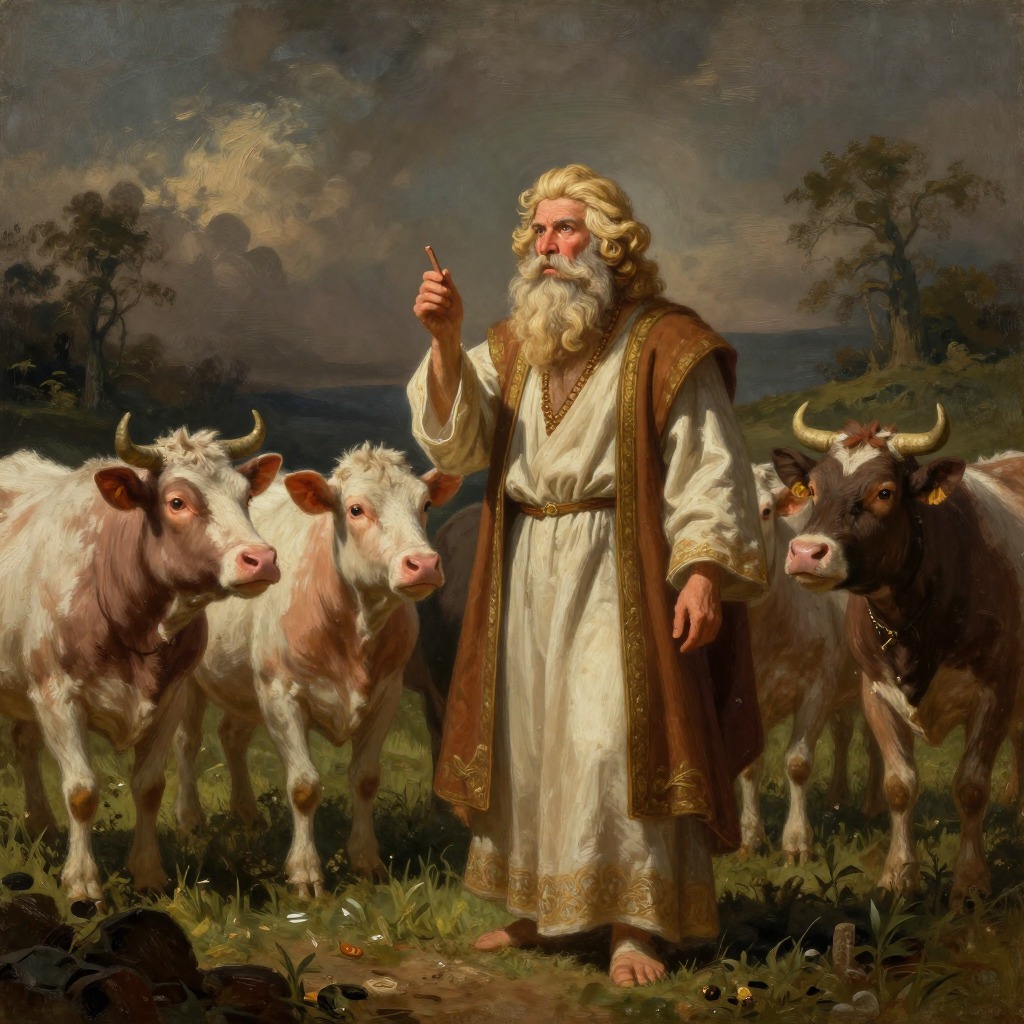
Moses
Moses is a tame raven who appears on Animal Farm as Mr. Jones's especial pet, a spy and a tale-bearer, but also a clever talker. He claims to know of the existence of a mysterious country called Sugarcandy Mountain, to which all animals go when they die. It is situated somewhere up in the sky, a little distance beyond the clouds, Moses says. In Sugarcandy Mountain it is Sunday seven days a week, clover is in season all the year round, and lump sugar and linseed cake grow on the hedges. The animals hate Moses because he tells tales and does no work, but some of them believe in Sugarcandy Mountain, and the pigs have to argue very hard to persuade them that there is no such place.
Role in the Rebellion and Expulsion
On the night of the Rebellion, when Mr. Jones is expelled, Moses springs off his perch and flaps after Mrs. Jones, croaking loudly, as she slips out of the farm by another way with a few possessions. He disappears from the farm for several years, during which time the pigs, especially Snowball and Napoleon, work to counteract the lies he had put about. The pigs have an even harder struggle to counteract the lies put about by Moses than to teach the principles of Animalism to the other animals.
Return and Tolerated Presence
In the middle of the summer, after the farm has been proclaimed a Republic and Napoleon is elected President, Moses suddenly reappears on the farm, after an absence of several years. He is quite unchanged, still does no work, and talks in the same strain as ever about Sugarcandy Mountain. He would perch on a stump, flap his black wings, and talk by the hour to anyone who would listen. "Up there, comrades," he would say solemnly, pointing to the sky with his large beak—"up there, just on the other side of that dark cloud that you can see—there it lies, Sugarcandy Mountain, that happy country where we poor animals shall rest for ever from our labours!" He even claims to have been there on one of his higher flights, and to have seen the everlasting fields of clover and the linseed cake and lump sugar growing on the hedges. Many of the animals believe him. Their lives now, they reason, are hungry and laborious; is it not right and just that a better world should exist somewhere else?
Ambiguous Relationship with the Pigs
A thing that is difficult to determine is the attitude of the pigs towards Moses. They all declare contemptuously that his stories about Sugarcandy Mountain are lies, and yet they allow him to remain on the farm, not working, with an allowance of a gill of beer a day. This tolerance stands in stark contrast to the pigs' earlier strenuous efforts to persuade the animals that there is no such place. The pigs' willingness to let Moses stay, idle and spreading his comforting fables, suggests that his tales of an afterlife serve a useful purpose: they offer a sop to the animals' present hardships, making them more resigned to their lot. Moses thus becomes a tolerated figure, a purveyor of religious consolation that the pigs themselves do not believe but find politically convenient.
Narrative Significance
Moses functions as a symbol of religious or otherworldly consolation that diverts attention from earthly oppression. His Sugarcandy Mountain is a direct parallel to the concept of religion as an opiate of the masses, a promise of reward in the afterlife that encourages acceptance of suffering in the present. The pigs' initial opposition to his lies and their later tolerance of him—even granting him a daily beer ration—illustrates their growing cynicism and their willingness to use any tool, even a comforting falsehood, to maintain control. Moses is one of the few animals who remembers the old days before the Rebellion, along with Clover, Benjamin, and a number of the pigs, and he outlasts many of the original revolutionaries, a persistent reminder of the human world's spiritual deceptions that the new regime has learned to exploit.